

Click on links for information on Parthian art and artifacts:
| Most historians substantiate the fact that making thread out of animal wool and weaving carpets out of wool and thread began and thrived at the time of Parthian kings in Iran. The histories of Tabari and Noruznameh testify to this fact with the authors of both attributing knitting and cloth making to the time of the Parthian dynasty. The most authoritative source available in this regard is the Shahnameh by Hakim Abolqassem Ferdowsi which attributes the Parthians as the first Iranians knitting and spinning.
|
| Almost all Parthian coins bear heads or busts on the obverse, and some also have reverse portraits. Many of the bronze coins have images other than the standard archer on the reverse. Visit the Coins of Parthia page and browse through these miniature pieces of Parthian art. There is also a special page containing a Gallery of Parthian Horses from the images on coins. |
| Parthian craftsmen created exquisitely beautiful drinking horns called rhytons from metal and other materials such as ivory. The animals on these vessels included the ram, horse, bull, ibex, supernatural creatures, and female divinities; some bear royal inscriptions. Rhytons of precious materials were luxury wares probably used at royal courts.
Visit the Parthian Rhytons page to
view some examples. |
| Cup with horned animals and trees (northwest Iran, 1st cent. B.C.) (Shumei Culture Foundation, Otsu, Shiga Japan) | |
| Dura Europos Fresco. Sacrifice of Conon. Temple of the Palmyrene gods. 1st. c. A.D. Graeco-Iranian style. | |
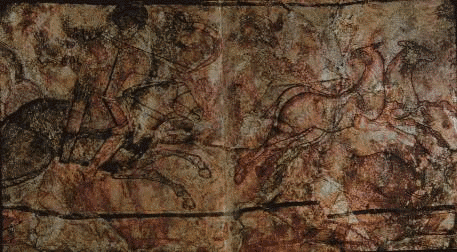
| Dura Europos Fresco. Horseman hunting onagers. Dura Europos, Mesopotamia, Parthia. 2nd c. A.D. 6.5 feet wide. (Paris: Louvre) | |
|
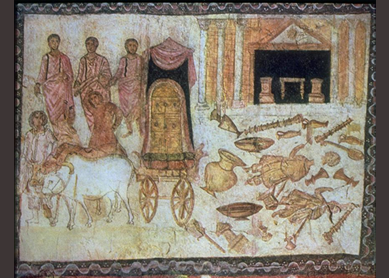
Dura Europos Fresco. Dura Synagogue. The Ark of the Covenant in temple of Dagon, god of the Philistines. 245-256 A.D. Dura Europos, Mesopotamia, Parthia. 59" tall. (Damascus Museum). Three stages in story are presented simultaneously, which is typical of third century narrative art. Dagon statue falls; sacred utensils are scattered; ark being removed from temple. |
This page last updated 14 Mar 2021








|

|

|